
In Lebanese culture and across the region, food is rarely just food. It is a welcome, a celebration, and one of the most heartfelt ways we care for one another.
When guests arrive, the table begins to fill. There is always another dish to bring out, another piece of bread to warm, and another invitation to eat a little more. Whether the occasion is a holiday, a family gathering, or an unexpected afternoon visit, offering food is a way of saying: You are welcome here. Stay awhile.
This spirit of hospitality is at the heart of Cedar & Thyme.
A Table Meant to Be Shared
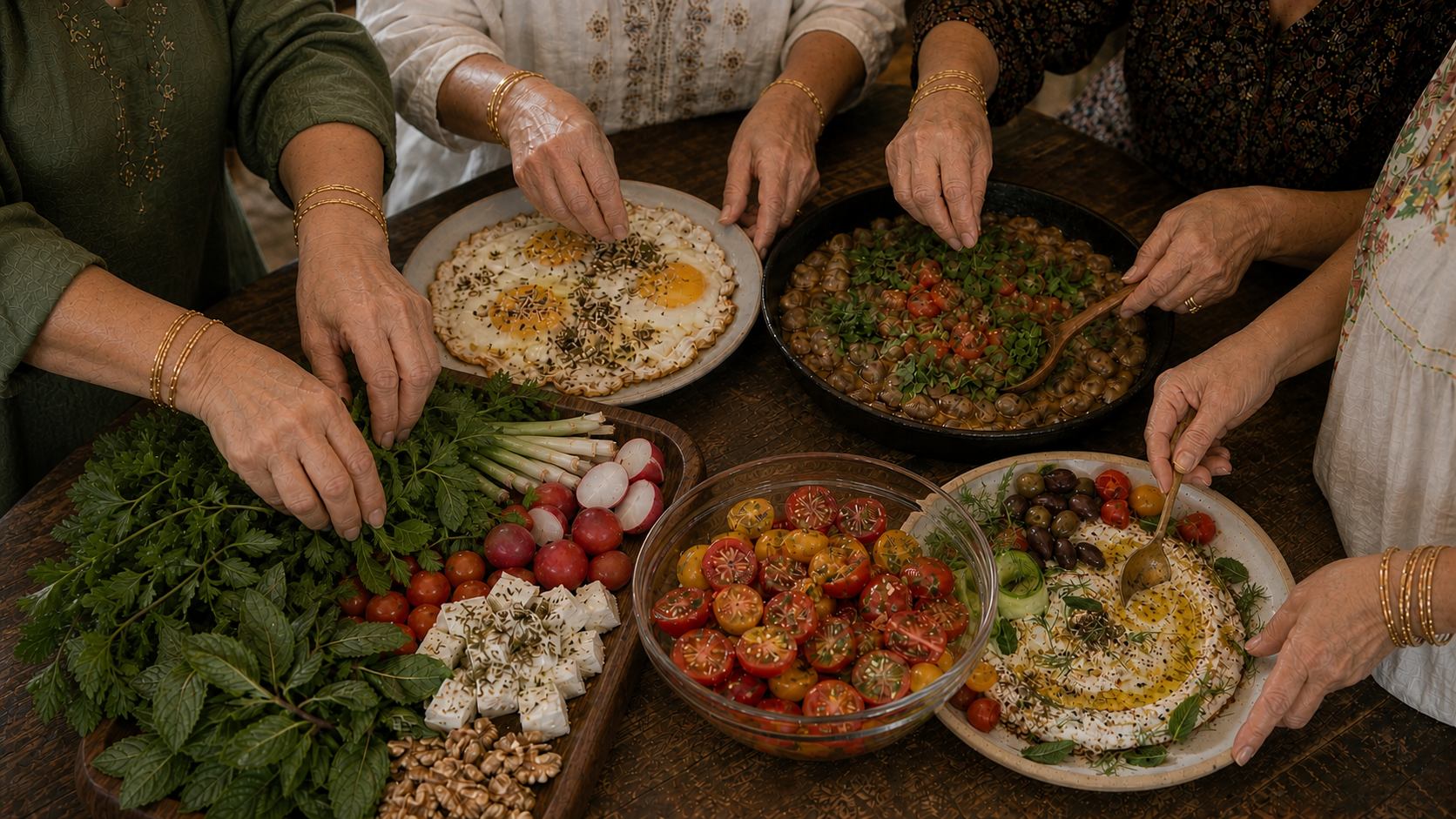
A traditional Lebanese table is abundant by nature. It might begin with small plates of creamy hummus, smoky baba ghanouj, tangy labneh, olives, pickled vegetables, fresh herbs, and warm bread. More dishes arrive as people settle in, each bringing new colors, aromas, and flavors to the gathering.
This style of dining is known as mezze, but its meaning extends far beyond the individual dishes. Mezze is designed for sharing. Guests reach across the table, pass plates to one another, taste a little of everything, and linger over conversation.
There is no pressure to hurry through distinct courses. The meal unfolds naturally, allowing everyone to slow down and enjoy the people around them.
That is what makes a Lebanese table feel so generous. Its abundance is not simply about the amount of food being served. It is about creating an atmosphere in which everyone feels included and cared for.
The Women Around the Table
Some of my most distinct childhood memories are of the women in our village coming together during harvest season. Whether they were making za’atar, preserving tomatoes into paste, or pressing freshly gathered olives into oil, preparing food was never a solitary task. It was an affair.
I remember the soft clicking of their gold bangles as their hands worked, and the sound of their laughter filling the room as they reminisced and exchanged stories. Recipes were prepared, news was shared, and memories were made—all at the same time. That is how I first came to understand food: not simply as something we make, but as something we make together.
Recently, my family came to visit. My brother is married to a wonderful Mexican woman, Jocelyn, who has been part of our family for nearly a decade. While the children played and picked on one another, my mother, sister, sister-in-law, and I gathered around the kitchen counter. Each of us took responsibility for some part of the dish, our hands busy as we laughed wholeheartedly together.
At one point, Jocelyn looked at me and said, “This is how I think of food—the women coming together to prepare it.”
Her words stopped me for a moment. There we were, women from different cultures and generations, recreating a ritual I had known since childhood. The ingredients and dishes may have changed, but the feeling was exactly the same.
It occurred to me then that this is why food transcends language and culture. It brings people together despite their differences. It communicates love when words fall short. And when the meal is finally placed on the table, it gathers everyone—filling our hearts and our stomachs at the same time.
When the last plate is cleared and the laughter begins to quiet, we are left with more than the memory of what we ate. Another story has been added to our family’s memory bank—another small but meaningful part of the legacy we are creating and passing on.
The Beauty of an Open Table
Lebanese hospitality has a remarkable way of making room for people.
There is room for the friend who arrives unexpectedly, for the neighbor who stops by, and for the guest who begins the evening as a stranger but leaves feeling like family. The table becomes a place where stories are exchanged, relationships deepen, and memories take shape.
Food helps create that connection because sharing it is such a natural act. Passing bread, offering someone a favorite dish, or encouraging them to try an unfamiliar flavor opens the door to conversation. The meal gives people a reason to gather, but the connection that forms around it is what they remember.
Bringing That Tradition to Cedar & Thyme
I had been enjoying what we now call charcuterie long before I ever knew the buzzword. Whenever Tata—my grandmother—or my mother was busy, she would gather whatever we had available and arrange it beautifully on a tray for us to enjoy. A simple assortment of cheeses, olives, vegetables, bread, dips, and other small bites became something abundant and special.
As I grew older and grazing tables became increasingly popular, I found myself yearning to see one filled with the flavors I had grown up eating. I wanted a table that offered more than familiar meats and cheeses—one that made room for the traditional dips, vibrant salads, fragrant pilafs, and treasured family recipes that had shaped my understanding of food.
These dishes may not be considered modern, but they are timeless and rich with flavor, history, and meaning. That longing inspired me to bring a Lebanese twist to charcuterie and grazing tables through Cedar & Thyme. Each table combines familiar favorites with flavors guests may be experiencing for the first time. It offers the comfort of something recognizable alongside the excitement of discovery.
At Cedar & Thyme, food becomes a way to travel across the world without leaving the table. You may arrive for the flavors you already love, but my hope is that you leave having discovered new ones—and feeling the same warmth and generosity that surrounded the trays Tata and my mother once prepared for us.
More Than a Meal
The most memorable tables are not necessarily the most elaborate. They are the ones around which people feel comfortable, connected, and genuinely welcomed.
That is the feeling we hope to create through Cedar & Thyme.
Our food is rooted in Lebanese tradition, but the invitation is for everyone. Whether we are preparing a table for an intimate celebration or a larger gathering, our purpose remains the same: to offer food generously, welcome every guest, and create a setting where people can enjoy being together.
Because hospitality is not measured only by what is placed on the table. It is measured by how people feel when they gather around it.
And when food is prepared with care and shared with an open heart, a meal becomes something much greater: a memory, a connection, and a place of belonging.
Leave a Reply